
2026-08-05 • BY D.T. Risenburg
The Science of Canine Super-Sniffers: How Dudley Tracks the Truth
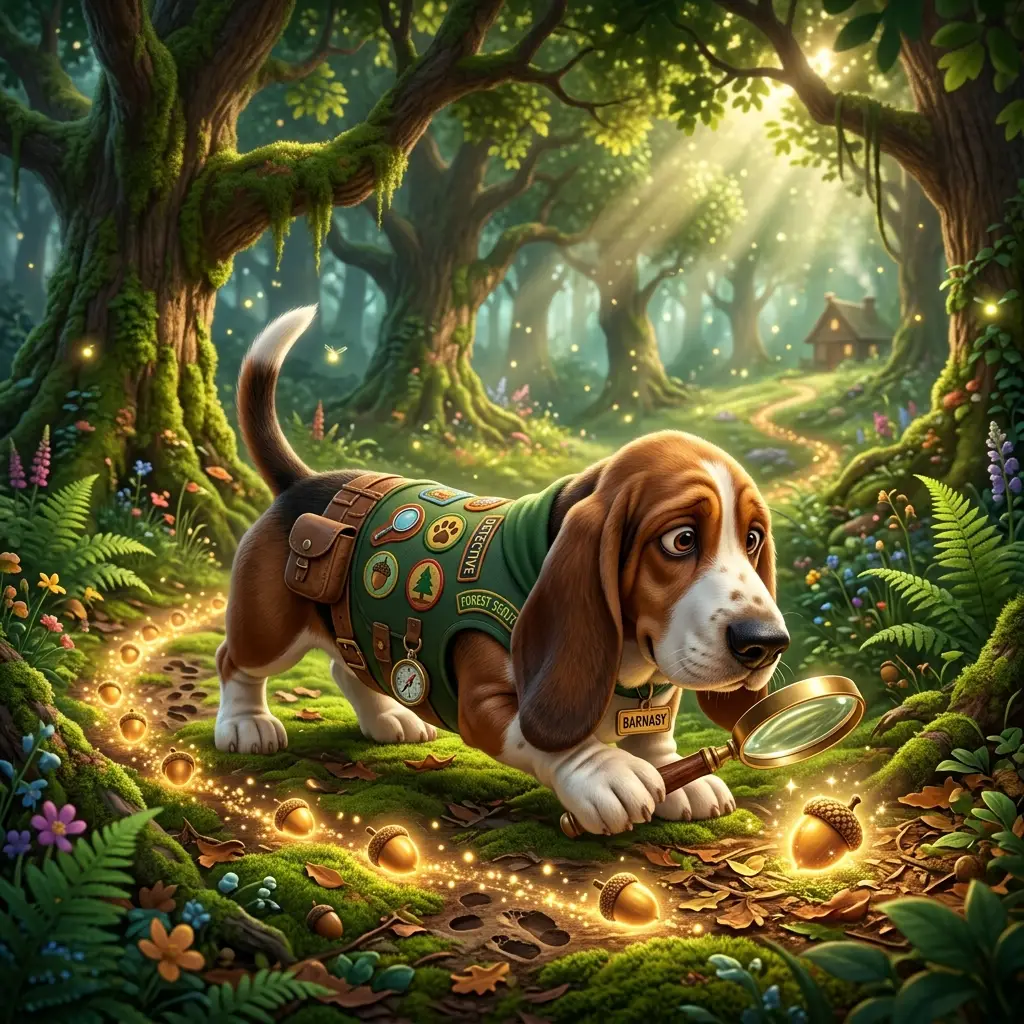
If you have ever watched a Basset Hound put his nose to the damp forest floor and instantly tune out the entire world, you have witnessed one of nature’s most extraordinary biological supercomputers in action. In Dukey & Dudley: And the Great Acorn Heist, Dudley’s legendary tracking nose is the primary investigative asset that allows the Woodland Defenders to locate the stolen acorn caches hidden deep within Oak Bark Park.
While human scent detection relies on roughly 5 million olfactory receptors located in a small patch high in the nasal cavity, a Basset Hound possesses over 220 million scent receptors. When combined with their signature long, velvety ears that act as natural broomsticks to sweep scent molecules upward toward the snout, these working hounds possess an uncanny ability to unravel scent trails that are hours or even days old.
The Anatomy of a Canine Super-Sniffer
To understand how Dudley tracks subtle scents through dense pine needles and damp mud, we have to look inside the canine nasal cavity. When humans inhale, we draw air through a single pathway where breathing and smelling occur simultaneously. Dogs, however, have a specialized fold of tissue inside each nostril that separates the incoming airflow into two distinct streams.
Approximately 88% of the air a dog inhales goes straight to the lungs for respiration. But the remaining 12% is routed into a dedicated olfactory region filled with hundreds of millions of specialized sensory neurons. This dual-pathway system ensures that scent molecules linger in the nasal cavity even while the dog exhales.
🔍 Key Biological Adaptations of Tracking Hounds:
- Stereo Olfaction: Dogs inhale through two independent nostrils. By measuring tiny differences in scent concentration between the left and right nostrils, a tracking hound can instantly determine whether an animal moved to the left or right.
- The Vomeronasal Organ (Jacobson's Organ): Located above the roof of the mouth, this specialized organ detects chemical signals and pheromones undetectable by human senses. It allows dogs to identify individual animals, emotional states, and environmental markers.
- Floppy Ear Sweep: The iconic long ears of Basset Hounds are not just adorable—when the dog walks with his nose low to the ground, the drooping ears sweep the grass and soil, stirring up dormant scent particles straight toward the nose.
- Loose Skin Folds: The wrinkled skin folds around a Basset Hound’s neck and chest trap lingering scent molecules, creating a pocket of concentrated scent around the face while tracking.
How Scents Linger and Travel in Nature
Scent tracking is not simply about smelling a single object; it is about reading a chronological story written in invisible chemical layers. When an animal like Ratticus or a woodland squirrel walks through Oak Bark Park, they leave behind microscopic skin cells, sweat secretions, and environmental disturbances such as crushed moss and bruised leaves.
Temperature, humidity, and wind play massive roles in how scent trails behave. On cool, humid mornings, scent molecules sink and cling to grass blades and damp soil, creating crisp, easy-to-follow trails. On hot, dry afternoons, thermal heat currents lift scent particles into the air, forcing tracking hounds to raise their heads and catch scent plumes drifting on the breeze.
In The Great Acorn Heist, Dudley demonstrates this exact real-world tracking behavior. When the trail on the main footpath grows dry under the afternoon sun, he pauses, dampens his nose, and catches the faint scent of crushed acorn husks drifting down from the higher oak canopy.
Fostering Scientific Curiosity in Children
Woven inside the detective adventure of Dukey & Dudley is a powerful opportunity to spark scientific curiosity in young readers. Children are naturally fascinated by animal superpowers, and learning the biological mechanics behind a dog’s nose connects storytime directly to real-world biology and sensory science.
💡 3 Fun Scent-Tracking Activities for Kids:
- The Cup Scent Shell Game: Place three opaque plastic cups upside down on the floor. Hide a fragrant treat or small scented toy under one cup and encourage your family pet or your child to find which cup holds the surprise!
- Backyard Scent Trail: Rub a piece of cinnamon bark or citrus peel along a garden path or patio. Have your child pretend to be Detective Dudley and follow the scent markers to uncover a hidden clue!
- Nature Observation Walks: On your next family walk, encourage your kids to notice how damp leaves, pine needles, and cedar bark smell different after rain. Discuss how wild animals use their senses to navigate.
Interactive Learning Across Oak Bark Park
Building scientific literacy and observational skills is at the core of our series. You can continue exploring animal tracking and detective work with your family by checking out our interactive Word Search Game, joining park defenders on the Woodland Guardianship Map, or baking safe canine snacks in Dudley's Basset Hound Bakery!
Explore More Woodland Adventures!
Join Dukey & Dudley on their quest, test your skills in the games room, or print mystery activity packs!